AI Investment Committee Example
This page describes one concrete agent-flow example: a four-agent investment committee. It is not the only way to build with LumiBot agents. Start with Agent Flows if you want the broader design space: single-agent flows, specialist desks, multi-model committees, iterated debates, and hybrid deterministic-plus-agent strategies.
The investment committee pattern is useful when you want a strategy to:
gather evidence from multiple built-in research tools
create separate bull and bear analyses
let one final portfolio manager weigh the evidence
keep all research roles read-only
submit orders only from the final trading-enabled step
Reference Implementation
The full runnable example lives at
lumibot/example_strategies/ai_investment_committee.py.
It runs inside normal LumiBot lifecycle code. There is no LangGraph dependency
and no external debate service. The strategy creates agents in initialize()
and calls them from on_trading_iteration().
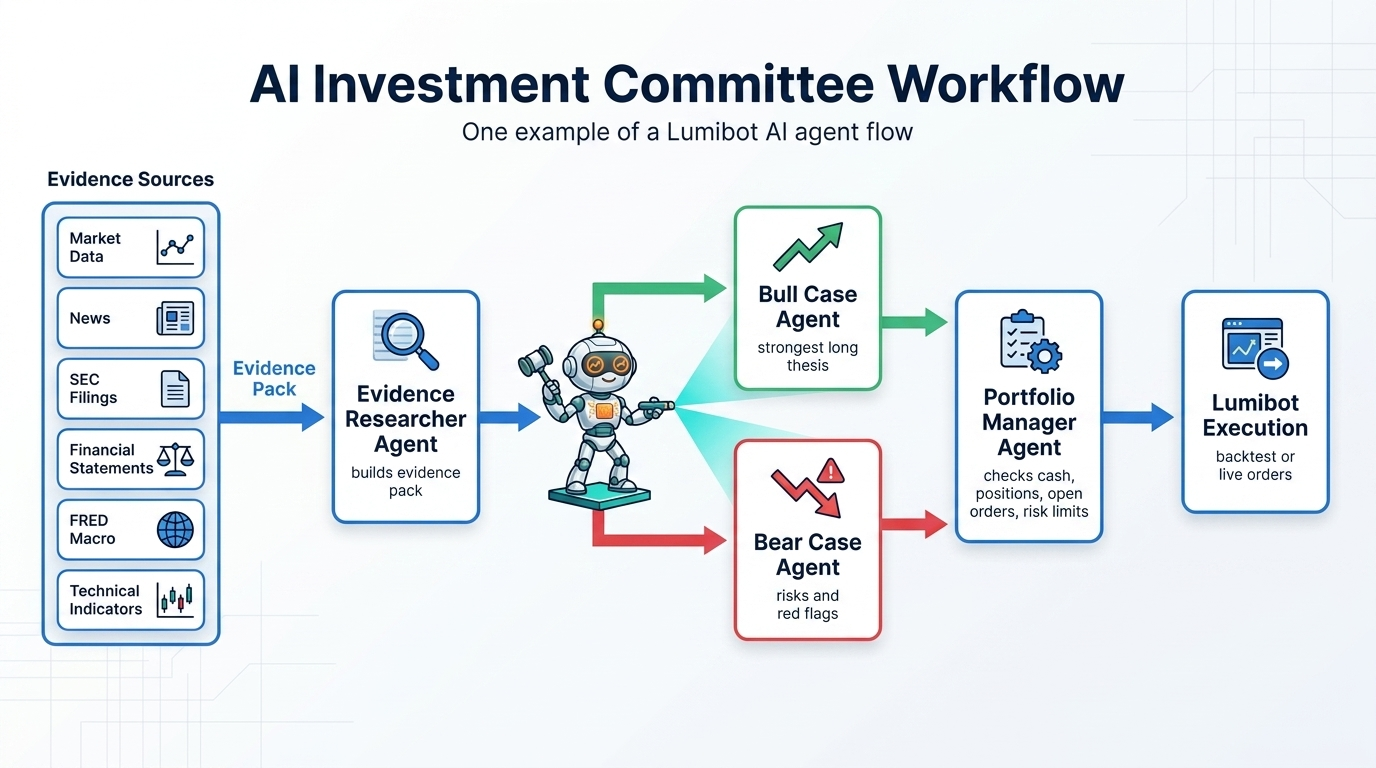
The four roles in this example are:
Evidence researcher – read-only. Builds the evidence pack from market data, indicators, news, SEC fundamentals, SEC filings, FRED macro data, account state, and any other read-only tools it needs.
Bull researcher – read-only. Builds the strongest long-only thesis.
Bear researcher – read-only. Attacks the thesis and identifies reasons to avoid, delay, reduce, or monitor the trade.
Portfolio manager – trading enabled. Reviews evidence, cash, positions, open orders, and risk limits before submitting orders.
Creating The Agents
Every role can use a different model. The example uses a cheaper model for evidence gathering and stronger models for bull, bear, and final portfolio reasoning, but those choices are configuration, not a framework requirement.
self.agents.create(
    name="evidence_researcher",
    model=os.environ.get("COMMITTEE_RESEARCH_MODEL", "openai/gpt-5.4-mini"),
    allow_trading=False,
    system_prompt=self._evidence_researcher_prompt(),
)
self.agents.create(
    name="bull_researcher",
    model=os.environ.get("COMMITTEE_BULL_MODEL", "openai/gpt-5.5"),
    allow_trading=False,
    system_prompt=self._bull_researcher_prompt(),
)
self.agents.create(
    name="bear_researcher",
    model=os.environ.get("COMMITTEE_BEAR_MODEL", "openai/gpt-5.5"),
    allow_trading=False,
    system_prompt=self._bear_researcher_prompt(),
)
self.agents.create(
    name="portfolio_manager",
    model=os.environ.get("COMMITTEE_TRADER_MODEL", "openai/gpt-5.5"),
    allow_trading=True,
    system_prompt=self._portfolio_manager_prompt(),
)
Running The Flow
The flow is just Python. The strategy passes one agent’s output into the next agent’s context.
evidence = self.agents["evidence_researcher"].run(
    task_prompt="Build the evidence pack for today's committee.",
    context=context,
)

bull = self.agents["bull_researcher"].run(
    task_prompt="Build the strongest long-only investment case.",
    context={**context, "evidence_pack": evidence.summary or evidence.text},
)

bear = self.agents["bear_researcher"].run(
    task_prompt="Attack the long case and identify reasons to avoid, delay, reduce, or monitor the trade.",
    context={
        **context,
        "evidence_pack": evidence.summary or evidence.text,
        "bull_case": bull.summary or bull.text,
    },
)

decision = self.agents["portfolio_manager"].run(
    task_prompt="Make the final long-only portfolio decision.",
    context={
        **context,
        "evidence_pack": evidence.summary or evidence.text,
        "bull_case": bull.summary or bull.text,
        "bear_case": bear.summary or bear.text,
    },
)
What The Evidence Researcher Should Gather
In this example, the research prompt tells the evidence researcher to gather:
market context and visible historical prices
technical indicators such as RSI, MACD, moving averages, volatility, ATR, and trend context
recent news when Alpaca credentials are available
SEC income statement, balance sheet, cash flow, and company facts
SEC filings and targeted filing searches for risks, margins, debt, liquidity, customer concentration, accounting changes, buybacks, dilution, and management commentary
FRED macro context for rates, inflation, labor, growth, liquidity, credit spreads, and market-risk series
The bull and bear researchers can also call read-only tools if they need to dig deeper.
Trading Safety
The important safety rule is allow_trading=False for all research roles.
Those agents can inspect evidence but cannot submit, cancel, or modify orders.
Only the portfolio manager has allow_trading=True in this example. It is
prompted to check cash, positions, open orders, and risk limits before trading.
How To Modify This Pattern
You can make this committee smaller, larger, deterministic, or multi-model:
Remove bull and bear and use only a researcher plus trader.
Add a neutral agent.
Add separate news, filing, macro, technical, or sector specialists.
Run OpenAI, Gemini, Claude, and Grok agents independently and compare their cases.
Iterate bull and bear rebuttals multiple times before the final decision.
Let agents only write research, then place orders with deterministic Python.
Add a hard Python risk gate after the portfolio manager’s recommendation.
The reference committee is a flagship example because it is easy to understand and demonstrates research, debate, permissions, memory, notifications, and real orders in one workflow. It is not a limit on what LumiBot can express.
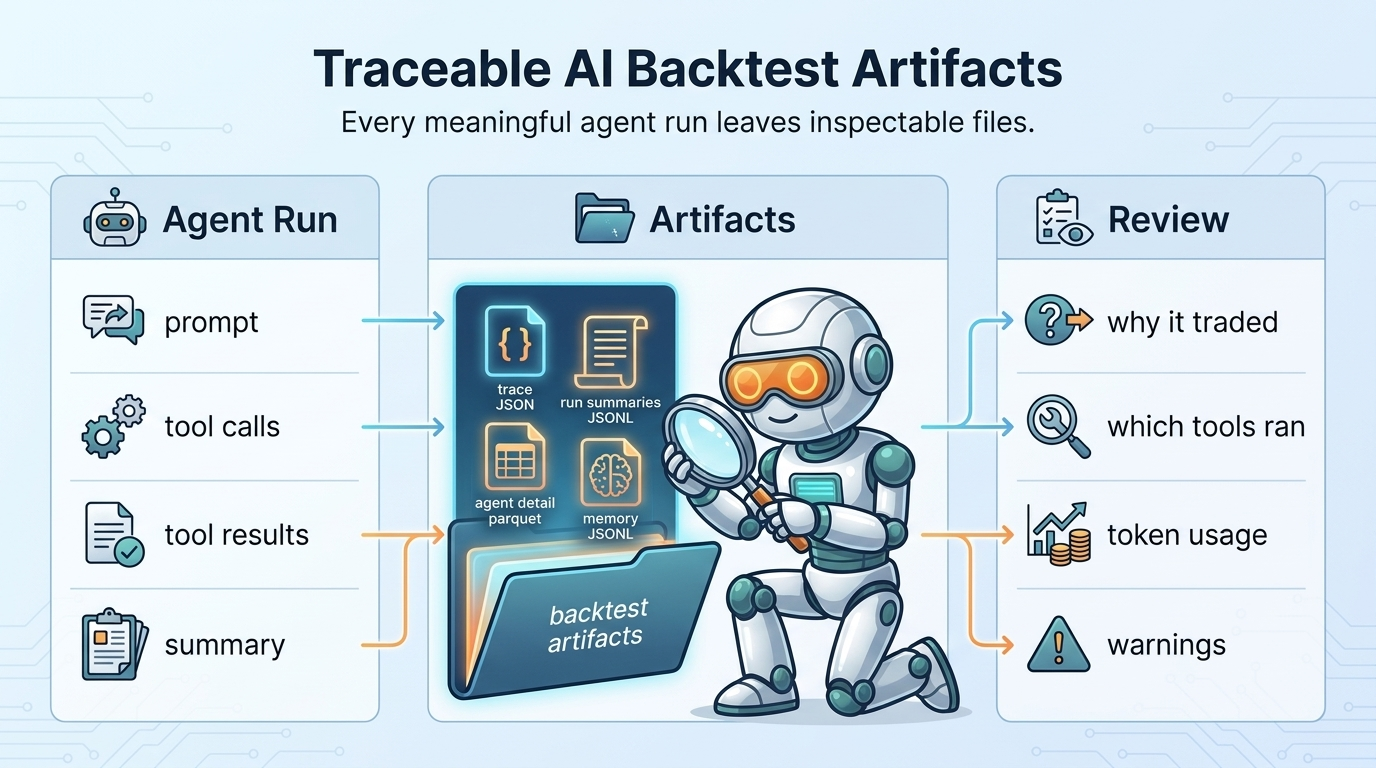
Backtest Artifacts
Committee runs leave normal LumiBot backtest artifacts plus agent traces, memory JSONL files, SEC/FRED cache files, and run summaries. This makes it possible to answer why a trade was placed after the backtest completes.