Design Your AI Trading Team
Start with Run your first AI backtest: one researcher gathers evidence and one trading agent owns risk review, order submission, and status reconciliation. Add researchers ahead of that trader when the strategy needs more perspectives. Research is evidence to evaluate, not permission to override the trading mandate.
An AI trading team is the way your strategy calls one or more agents during normal
LumiBot lifecycle methods such as on_trading_iteration(). It is just Python.
There is no required graph framework, no fixed team structure, and no
single “correct” shape.
You can use one agent, fifteen agents, a deterministic strategy with one AI review step, or a full multi-model debate. LumiBot provides the agent runtime, built-in tools, point-in-time backtesting, replay artifacts, and order permissions. Your strategy decides the flow.
Two Strategy Styles
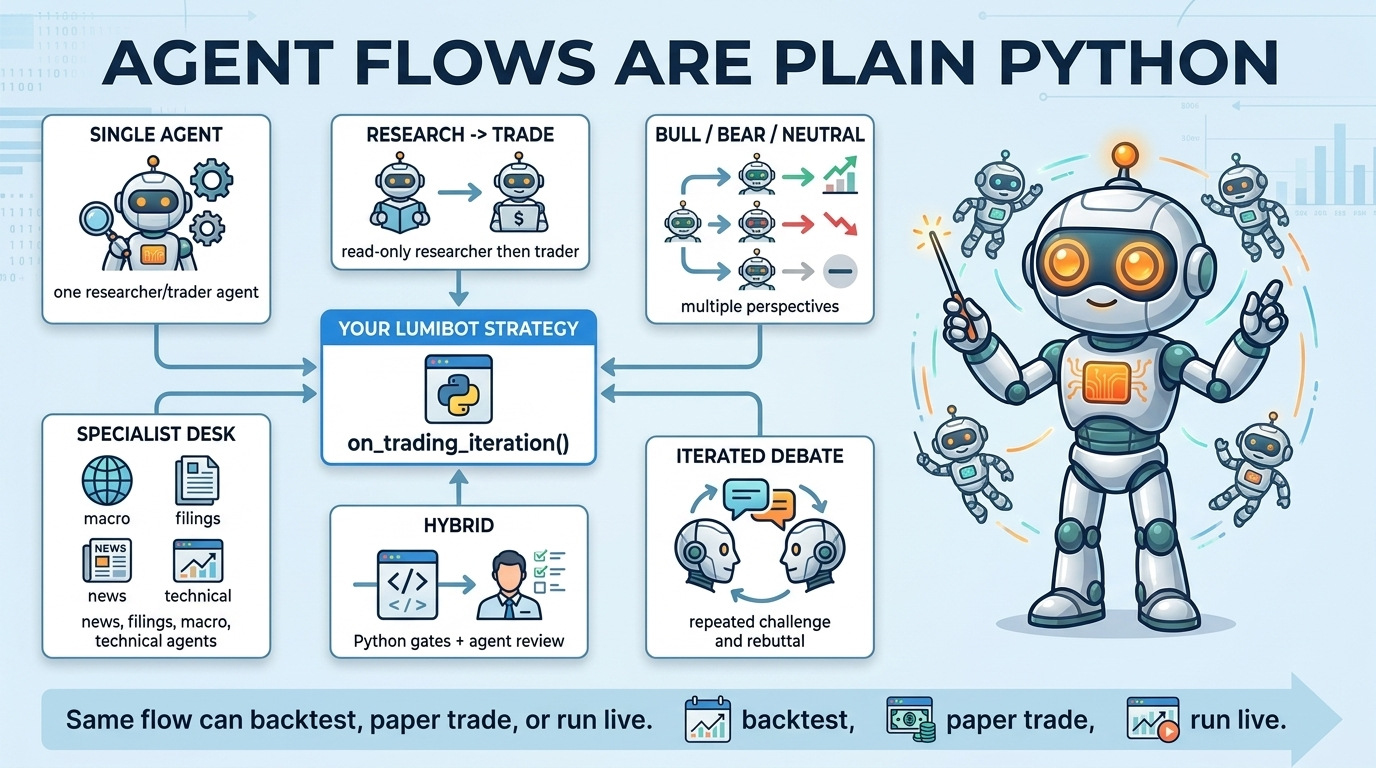
Most strategies are one of these, or a hybrid:
Deterministic strategy – Python code makes the decision with fixed rules: indicators crossing, time-of-day logic, thresholds, portfolio constraints, and explicit if/else branches.
Agent-powered strategy – one or more agents reason over evidence, call tools, summarize their views, and optionally place orders.
Hybrid strategy – Python gates the setup, agents review the context, and deterministic code may still size, filter, or submit orders.
The same LumiBot strategy can be backtested first and then run against paper or live brokers.
Common Flow Patterns
- Single analyst
One agent reads the current market state and returns a decision or a structured recommendation. This is the simplest starting point.
- Research then trade
A read-only research agent gathers evidence. A trading-enabled agent reviews that evidence and decides whether to submit orders.
- Bull, bear, neutral
Multiple read-only agents receive the same evidence pack and argue from different perspectives. A final portfolio manager weighs the views.
- Specialist research desk
Separate agents gather different inputs: news, SEC filings, macro data, technical indicators, alternative data, risk, sector context, or valuation. Their summaries feed a decision agent or deterministic order logic.
- Multi-model team
Several providers or models produce independent bull and bear cases. A final synthesis step compares them. For example, OpenAI, Gemini, Claude, and Grok can each produce a view before one portfolio manager decides.
- Iterated debate
Agents can run in sequence more than once: bull, bear, bull rebuttal, bear rebuttal, risk review, final decision. This costs more tokens, so it is best used selectively.
- Deterministic execution
Agents can stop at research. The final trade can still be placed by normal Python code if you want deterministic sizing and order submission.
- Risk gate
A strategy can put hard Python risk checks after the agent decision: maximum position size, no shorting, symbol allowlist, drawdown stop, or per-trade dollar limits.
Minimal Two-Agent Flow
def initialize(self):
    self.agents.create(
        name="researcher",
        model="openai/gpt-6-luna",
        allow_trading=False,
        system_prompt="Gather evidence. Do not trade.",
    )
    self.agents.create(
        name="trader",
        model="openai/gpt-6-luna",
        allow_trading=True,
        system_prompt="Review evidence, check risk, and trade only when justified.",
    )

def on_trading_iteration(self):
    evidence = self.agents["researcher"].run(
        task_prompt="Research the current setup for AAPL, MSFT, and NVDA."
    )
    decision = self.agents["trader"].run(
        task_prompt="Make the final decision.",
        context={"evidence": evidence.summary or evidence.text},
    )
    self.log_message(decision.summary)
Larger Specialist Flow
This is still normal Python. You can create many read-only agents, run them, and pass the outputs forward.
def initialize(self):
    for name, prompt in {
        "news_researcher": "Find recent news and catalysts.",
        "filing_researcher": "Search SEC filings for risk and opportunity.",
        "macro_researcher": "Review rates, inflation, labor, liquidity, and credit.",
        "technical_researcher": "Review trend, volatility, RSI, MACD, and moving averages.",
        "bull_case": "Build the strongest long thesis.",
        "bear_case": "Find the strongest reasons not to trade.",
        "neutral_case": "Give a balanced probability-weighted view.",
    }.items():
        self.agents.create(
            name=name,
            model="openai/gpt-6-luna",
            allow_trading=False,
            system_prompt=prompt,
        )

    self.agents.create(
        name="portfolio_manager",
        model="openai/gpt-6-luna",
        allow_trading=True,
        system_prompt="Weigh the research, check risk limits, then place orders only if justified.",
    )
In the trading iteration, your strategy decides whether these agents run in a chain, in parallel, only on certain symbols, or only when deterministic filters find an interesting setup.
Hybrid Deterministic + Agent Flow
Agents do not need to place trades. A strategy can ask agents for research and then use normal Python for the actual order.
import json

def _agent_json_dict(result) -> dict:
    """Fail closed unless the agent returns valid JSON with approved=true."""
    raw = result.text or result.summary or "{}"
    try:
        payload = json.loads(raw)
    except (TypeError, json.JSONDecodeError):
        return {"approved": False, "reason": "agent did not return valid JSON"}
    return payload if isinstance(payload, dict) else {"approved": False, "reason": "agent returned non-object JSON"}

def on_trading_iteration(self):
    if not self.indicators.crossed_above("SPY", "sma_20", "sma_50"):
        return

    review = self.agents["risk_reviewer"].run(
        task_prompt=(
            "Review whether this SMA crossover is worth trading today. "
            "Return only JSON with this shape: "
            '{"approved": true|false, "reason": "short explanation"}'
        )
    )

    decision = _agent_json_dict(review)
    if decision.get("approved") is True:
        order = self.create_order("SPY", 10, "buy")
        self.submit_order(order)
    else:
        self.log_message(f"Skipped trade: {decision.get('reason', 'not approved')}")
This pattern is useful when you want explainability or research from the agent but still want deterministic order sizing and execution.
Choosing Models Per Agent
Every agent can use its own model. The default is openai/gpt-6-luna on medium
reasoning, and it is a good choice for every role. Most strategies do not need
many models. Override model= on one agent only when you have a reason, for
example a different provider when you want an independent perspective.
For a four-agent trading team, that can look like this:
self.agents.create(name="evidence_researcher", model="openai/gpt-6-luna", allow_trading=False)
self.agents.create(name="bull_researcher", model="openai/gpt-6-luna", allow_trading=False)
self.agents.create(name="bear_researcher", model="openai/gpt-6-luna", allow_trading=False)
self.agents.create(name="portfolio_manager", model="openai/gpt-6-luna", allow_trading=True)
Safety Defaults
Use allow_trading=False for every agent that should not mutate broker
state. That agent can still inspect read-only state and research tools. Only
the final trader, portfolio manager, or deterministic Python code should submit,
modify, or cancel orders.
Where To Go Next
Agent Built-In Tools explains the built-in tools available to agents.
AI Trading Bot Examples lists the copy-paste AI trading team examples.
Agent Memory explains how agents can remember decisions and lessons.
AI Agent Observability explains traces and replay artifacts.
Learn AI trading with the creator of LumiBot
Learn with Rob Grzesik, creator of LumiBot. Explore the AI Trading Bootcamp.