Agent Memory
Lumibot includes native local memory for agentic strategies. Memory lets an agent record why it made a decision, search prior lessons, keep an open thesis, and leave artifacts that a human can inspect after a backtest or live run.
Memory is SQLite-backed while the strategy runs. SQLite gives Lumibot a real local database for append-only events, projections, retrieval provenance, and future backend portability without requiring Postgres or a vector database for local use.
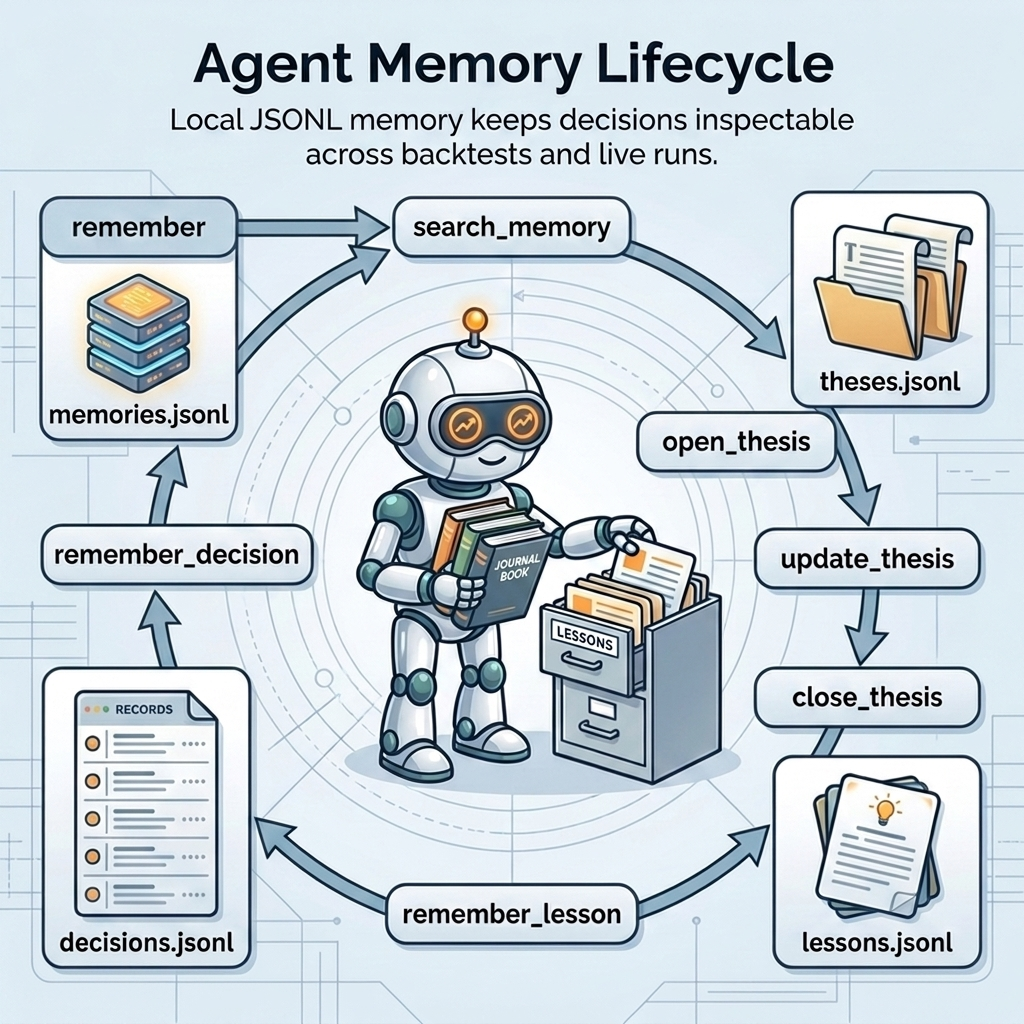
Why Memory Exists
Trading agents need more than a one-shot prompt. Useful memory answers questions such as:
Why did the agent buy, hold, reduce, or skip?
What evidence mattered at the time?
Which thesis is still open?
What lesson was validated after an outcome?
Did the same risk appear in a prior iteration?
Did the agent retrieve the open thesis before changing a held position?
This makes AI strategies easier to audit. It also gives future agent calls a small, searchable context instead of forcing every run to rediscover the same facts.
Backtest And Live Parity
Memory is available in both backtests and live trading. In a backtest, entries use the simulated strategy datetime when Lumibot can provide it. In live trading, entries use real current time.
That matters because Lumibot’s core design goal is parity: the same strategy code should behave the same way whether it is replaying history or connected to a broker. Memory should be part of that same strategy lifecycle, not a live-only side channel.
Storage
By default, memory is stored under:
.lumibot/memory/<strategy_name>/
   memory.sqlite
   agent_memory_memory_events.parquet
   agent_memory_memory_retrievals.parquet
   agent_memory_memory_state.parquet
Override the root directory with:
export LUMIBOT_MEMORY_DIR=/path/to/lumibot-memory
Set LUMIBOT_MEMORY_EXPORT_PARQUET=0 to disable best-effort Parquet exports.
Data Model
The SQLite database has three core tables:
memory_eventsAppend-only ledger of memory writes, proposals, risk notes, decisions, lessons, thesis changes, submitted orders, warnings, outcome observations, and other memory events.
memory_indexCurrent searchable projection of memories, decisions, lessons, and theses. This is the fast path for
search_memoryand compact state injection.memory_retrievalsRetrieval provenance for every
search_memorycall: query, filters, candidate IDs, selected IDs, and the rendered text made available to the agent.
Lumibot writes to SQLite during execution. Parquet files are derived artifacts for review, DuckDB queries, BotSpot uploads, and post-run analysis.
When a memory event or retrieval comes from an agent tool call, Lumibot records
agent_name and model_call_id. The model_call_id is the stable
replay-cache key for that agent request, so memory artifacts can be joined back
to agent_detail.parquet.
Agent Tools
Agents get these memory tools by default:
rememberStore a general note with optional tags.
search_memorySearch local memories, decisions, lessons, and theses. It supports
kind,symbol, andstatusfilters. Every call is recorded inmemory_retrievals.remember_proposalRecord a non-final research proposal or trade idea. This is available to read-only agents.
remember_risk_noteRecord a compact bear-case or risk note. This is available to read-only agents.
remember_decisionRecord an actual trading decision with optional symbol, action, evidence, and tags. This is reserved for trading-capable agents, because a read-only researcher should not write memory that looks like an executed decision.
remember_lessonRecord a compact lesson. Lessons are
proposedby default and should only becomevalidatedwhen outcome metadata confirms they held up.open_thesisOpen an investment thesis, usually before or at trade entry.
update_thesisReplace the current searchable thesis text while keeping the full event history in
memory_events.close_thesisClose a thesis with optional outcome metadata.
Compact State Injection
Every agent call receives a small Lumibot Memory State JSON section. It
contains:
open theses
current position rationales
validated lessons
the retrieval policy
This injected state is intentionally compact. It gives the model the current
state of memory without flooding the prompt. Deeper history should be retrieved
with search_memory.
The separate _agent_runtime_state entry in self.vars keeps bounded
prompt notes and run metadata for lifecycle continuity. It does not duplicate
full model summaries. Full history belongs in SQLite memory and agent
observability artifacts.
Lumibot also records execution-side memory. When an agent submits an order with
orders_submit_order, Lumibot writes an append-only order.submitted
event after the order is submitted. Open theses receive a best-effort daily
thesis.outcome_observed event while the symbol is held, including current
quantity, last price when available, and market value when available.
Thesis Retrieval Warnings
When an agent already holds a position and uses an order tool to add, reduce,
or sell that symbol, it should first call search_memory for the open
thesis.
Lumibot does not block the order if the agent skips retrieval. It records a
non-blocking observability warning and a memory event. This keeps the trading
path unblocked while making the behavior visible in agent_detail.parquet and
*_memory_events.parquet.
Common Patterns
- Decision journal
Ask the final decision agent to call
remember_decisionwhenever it buys, sells, reduces, or explicitly skips a high-conviction setup. Keep the entry compact: action, symbol, main evidence, risk, and expected invalidation.- Private order rationale and public summary
Order submission, multileg submission, modification and cancellation tools require a private
reasonfor the owner’s audit trail. They also accept an optionalpublic_reason: a separate short summary intended for sharing. Private reasons are never used as a fallback for a public post.Keep public summaries within 280 UTF-8 bytes. Exclude names, account numbers, credentials, bank information and account balances. An invalid public note is omitted while the valid private order action continues. A public note alone does not authorize Community publication: the owner’s filled-trade and explanation-sharing settings and the server’s privacy checks still apply.
- Thesis tracking
Use
open_thesiswhen the agent enters a position,update_thesiswhen evidence changes, andclose_thesiswhen the position exits or the thesis is invalidated.- Validated lessons
Proposed lessons are cheap to write. Validated lessons should require outcome data. This prevents the model from treating every reflection as a proven rule.
- Search before acting
Before changing a held position, ask the agent to call
search_memoryfor the symbol and open thesis. This helps the agent compare the original reason for the trade against current evidence.
Example Prompt
self.agents.create(
    name="portfolio_manager",
    model="openai/gpt-6-luna",
    allow_trading=True,
    system_prompt=(
        "Review evidence and risk before trading. "
        "Before changing a held position, search memory for the open thesis. "
        "After the decision, record a compact decision memory with the "
        "symbol, action, main evidence, and invalidation condition."
    ),
)
What Memory Is Not
Memory is not a risk-management substitute. Hard constraints such as maximum position size, no-shorting rules, cash reserves, drawdown stops, and symbol allowlists should still live in Python code or broker/account configuration.
Memory is also not a guarantee that an LLM will improve over time. It is a structured, inspectable context source. The strategy still controls when memory is searched, what tools are available, and whether orders can be submitted.
Traceability
Memory complements Lumibot’s normal backtest artifacts. Agent traces show the prompt, tool calls, tool results, and summaries. Memory artifacts show what the agent preserved, what it retrieved, and what current state was available.
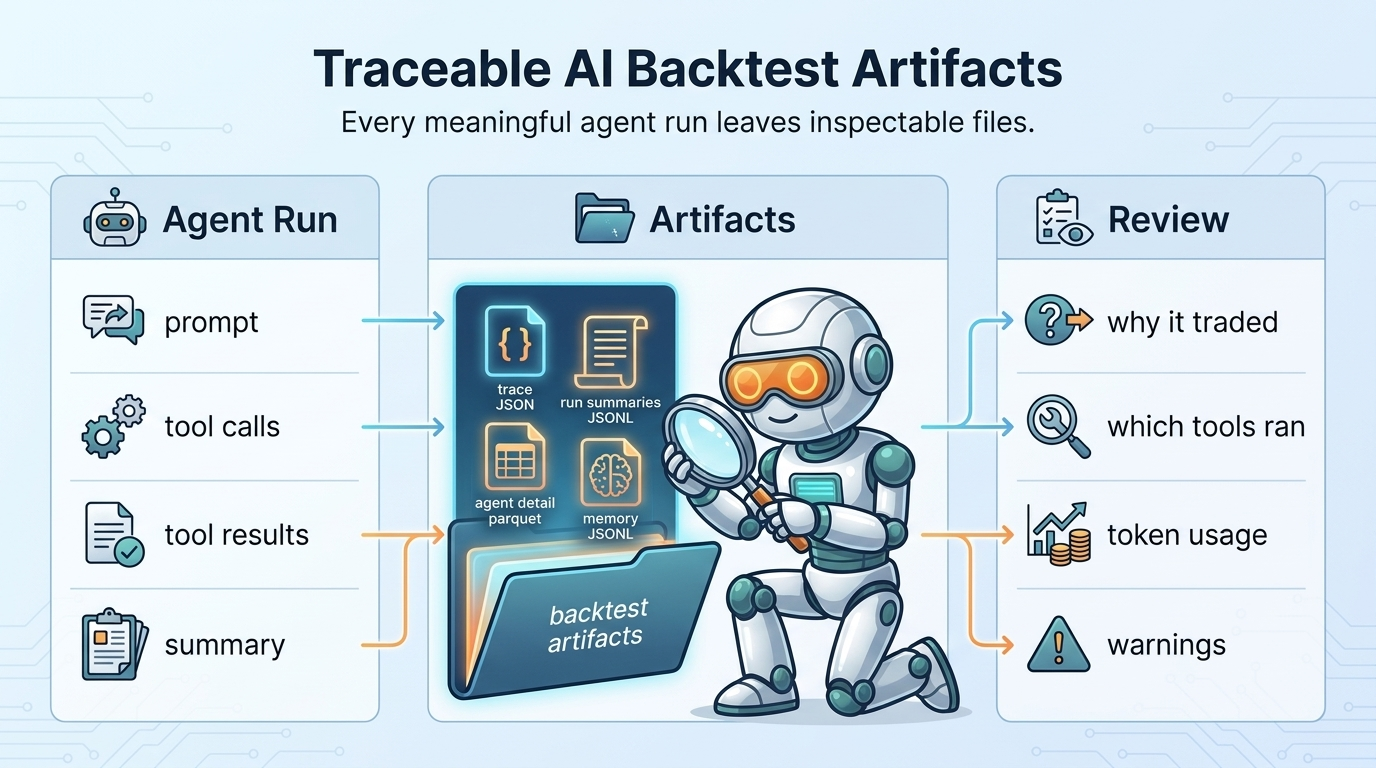
Review memory after a run when you want to answer:
Why did the agent trade?
Which evidence did it preserve?
What thesis was open at the time?
What lesson did it write after the outcome?
Did the agent search prior memories before acting?
Did the agent retrieve memory before changing a held position?
Order Decision Journal
Every built-in order submission, modification and cancellation requires an
explicit reason of at least 200 characters. Explain dated evidence, sizing,
risks and invalidation. This is a decision summary, not hidden model reasoning.
Aim for 600–2,500 characters; the hard limits are 100,000 Unicode characters and
400 KiB of UTF-8. Optional JSON evidence and order snapshots share a 1 MiB
intent limit. Invalid input fails before execution.
Python strategies can use the same reason= and evidence= parameters.
Existing deterministic Python strategies remain compatible. LumiBot commits
order.intent in SQLite before calling the broker. Full text stays in private
memory artifacts; orders and fill logs carry compact decision/action references,
previous action, model call, configured revision, timestamp and a SHA-256 hash.
A broker timeout leaves an unknown outcome; reconcile it before retrying. A returned submission is not a confirmed fill. An outcome logging failure after acknowledgement does not turn the broker call into a failed trade. Journals are private; public sharing requires separate owner consent from the hosting service.
Explicit Community Posting
Use from lumibot.components.community import CommunityClient and
CommunityClient(api_key=...).post(body) only with owner-authorized public
posting and a dedicated Community-only key. Optional
marketplace_listing_id, publication_id and verified_trade_source
request server verification of an owned trade. parent_post_id replies in a
root thread. The finite-timeout client never retries an uncertain publication.
Recording a private explanation does not enable public posting.