AI Trading Examples

Start with a complete strategy, run a historical backtest, and inspect what the agents decided. Model calls require a provider key. Each example states its data requirements and whether the displayed result is a recorded run.

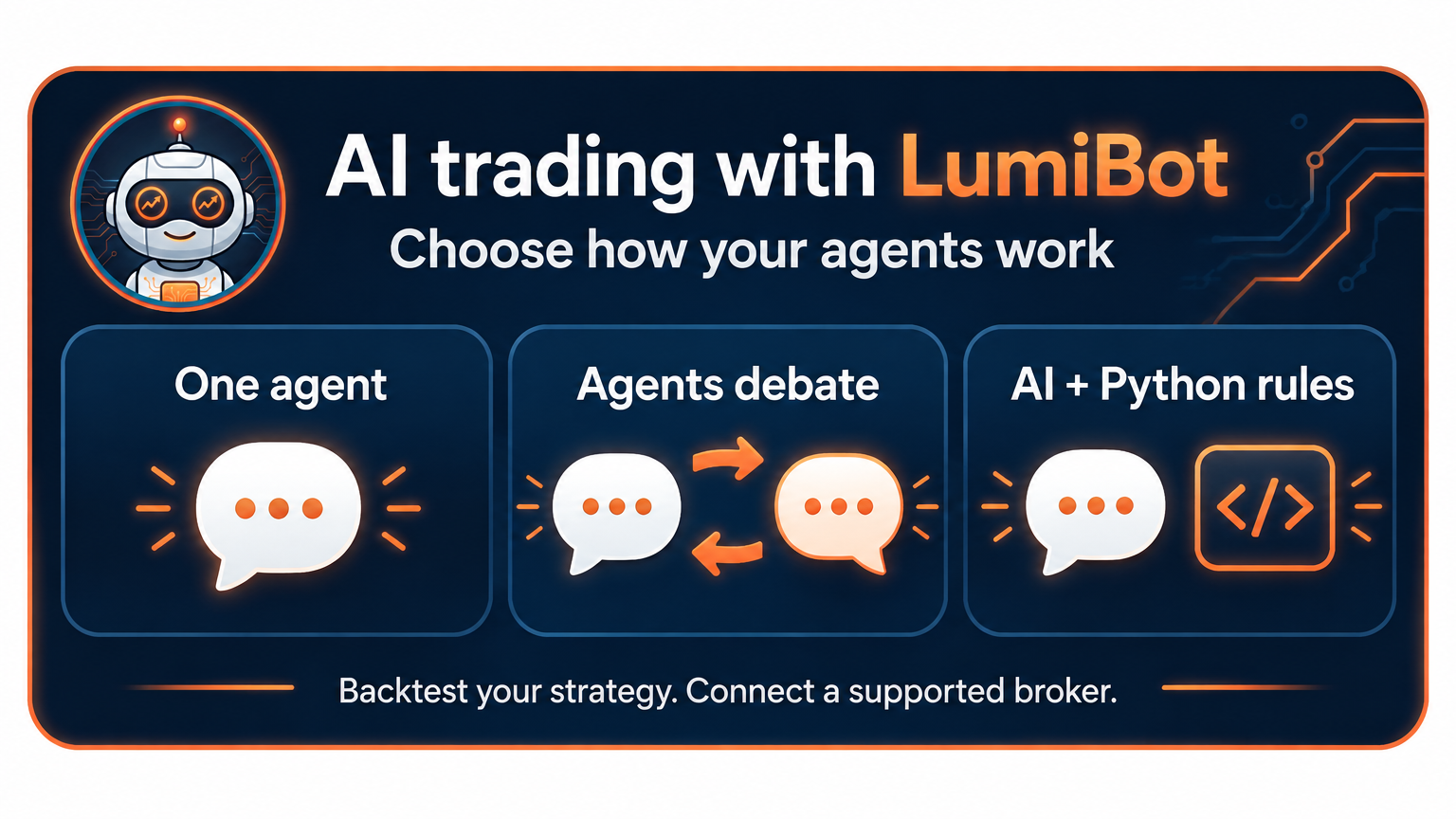
AI trading with LumiBot: one agent, agents that debate, or AI combined with Python rules.

First AI backtest

SPY trend research, risk review, and a trading agent. A small starting point.

Run the SPY example →

Agents that debate

Researcher, bull, bear, and trader working with familiar large-cap stocks.

See the stock team →

Options strategies

Explore an iron condor with its contracts, data setup, and recorded evidence.

Explore the iron condor →

Compare the workflows below. A fresh model run may produce different decisions and returns; saved traces show what happened in a particular run.

Stocks

Stock workflows

Example

What it does

Data and cadence

Evidence

Large-cap bull/bear team

Researcher, bull, bear, and interpreter set weights; one trading agent rebalances names such as Apple, Microsoft, and Nvidia.

Yahoo daily prices, one decision per session.

GPT-6 Luna, January 5 to 15, 2026: split the account across four names, rebalanced daily without churn, kept cash positive, and ended down 2.16% while SPY rose about 1%.

Opening range breakout

Inspect completed opening bars and trade a confirmed breakout.

Alpaca minute bars, evaluated every two hours.

GPT-6 Luna, January 5 to 6, 2026: traded DE, DIS, and SPGI at about 10% of the account and finished down 0.08%. One SPGI buy and sell landed in the same bar.

VWAP

Explore VWAP reclaim and mean reversion.

Alpaca minute bars.

GPT-6 Luna, January 5 to 6, 2026: no dip-and-reclaim setup appeared, so it stayed in cash. That is the intended no-trade result.

Value research team

Research business quality and challenge valuation.

Yahoo daily prices, then a real EDGAR read through get_filings and get_filing_section.

GPT-6 Luna, January 5 to 15, 2026: bought 708 PG with nearly the whole account and finished up 2.64%. Cash never went negative.

Concentrated stock team

Debate one high-conviction large-cap position.

Yahoo daily prices, then a real SEC company atom fetch for Pershing Square.

GPT-6 Luna, January 5 to 15, 2026: opened GOOGL and MSFT, later added UBER, and finished up 3.95%. Cash never went negative.

ETF and macro teams

Team workflows

Example

What it does

Data and cadence

Evidence

Sector pods

Sector specialists present ideas to a portfolio manager.

Daily ETF prices; inspect the published revision for additional data requirements.

Source example. Its public listing was withdrawn because the backing backtest overspent cash.

Macro idea meritocracy

Growth, inflation, and liquidity agents debate allocation.

Daily ETF prices; FRED/ALFRED is available for macro extensions.

Source example. Its public listing was withdrawn because the backing backtest overspent cash.

Leveraged ETF bull/bear team

Debate leveraged long and inverse ETFs such as TQQQ against SQQQ and UPRO against SPXU.

Yahoo daily prices. The trader holds one direction per index.

GPT-6 Luna, January 5 to 15, 2026: held UPRO and later TQQQ, never an ETF and its inverse together, kept cash positive, and ended up 1.47%.

Options strategies

Options workflows

Example

What it does

Prerequisites

Evidence

Iron condor

Open one four-leg package sized to the risk budget and close it after prices can move.

Alpaca option history.

GPT-6 Luna, January 5 to 15, 2026: opened 38 SPY February 645/650 put and 715/720 call spreads at real Alpaca prices and ended at $99,734.

Credit spread

Open one vertical credit spread sized to the risk budget and close it after prices can move.

Alpaca option history.

GPT-6 Luna, January 5 to 15, 2026: sold 33 SPY February 655/650 put spreads at real Alpaca prices and ended at $100,627.

SPX zero-DTE bear-call team

Open and close one SPXW bear call on the same expiration day.

Alpaca SPXW minute history. January 5, 2026 used the 6900 and 6910 calls.

Real QuantStats tear sheet. Open and close both filled. Ending value about $99,925.

Public disclosures and browser automation

Disclosure and browser workflows

Example

What it does

Availability boundary

Evidence

Congress disclosures

Read the House Clerk yearly index and PTR PDF, then trade the stock or the listed option after the filing is public.

ReportDate or source publication time, never the earlier transaction date. Amounts are ranges. A report can be up to 45 days late. An option row without strike and expiration is skipped.

Does not ship sample trades. Official House and Senate filings are public. Point-in-time tests use invented clock rows, not a member portfolio.

SEC Form 4 insider filings

Read point-in-time Form 4 filings for a watchlist, then tilt an equal-weight book toward insider buying.

SEC EDGAR submissions and filing documents, capped at the backtest clock.

Only filings accepted before the backtest clock are visible.

Authenticated browser research

Log in to an authorized JavaScript application, research, trade, and optionally publish a truthful receipt.

The observed page state and screenshot receipt at strategy time.

Local real-browser acceptance test plus a 100-cycle session restart soak.

Before running a strategy

The original team files default to a broker runner. The stock tutorial supplies a separate complete backtest runner so learning does not require editing that mode flag or supplying broker keys. Other examples may use an explicit backtest runner; read each page before executing its module.

A successful historical run verifies software behavior for that source, data, and window. It does not establish investment performance. An LLM may know future facts despite historical market-tool timestamps. These examples are inspired by public ideas, without affiliation or endorsement from named people or firms.

Build your own AI trading bot

Want help turning your idea into a strategy? Learn with Rob in the free challenge.

Learn with Rob Grzesik, creator of LumiBot. Join the FREE challenge.